
EV Fires vs Gasoline Fires: Why Suppression Strategies Can’t Be the Same
- TL-X

- Jul 28, 2025
- 3 min read
Updated: Jan 15
Not all fires behave the same
A common assumption in fire safety is that a fire is a fire, and that similar suppression strategies will work regardless of the fuel source. That assumption breaks down when lithium-ion batteries are involved.
When comparing EV fire vs gasoline fire behavior, the difference is not just intensity; it’s the underlying failure mechanism. These differences matter when designing safety strategies for vehicles, charging infrastructure, parking structures, and energy storage systems.
Gasoline fires: external, fuel-limited events
Gasoline fires follow a relatively predictable pattern:
Fuel is stored outside the ignition source
Combustion depends heavily on ambient oxygen
Once fuel is consumed, isolated, or covered, the fire subsides
Because of this, conventional suppression strategies are effective:
Foam to isolate fuel
Oxygen displacement
Water for cooling and control
The fire is driven by external fuel availability.
EV Fire vs Gasoline Fire: Internally Driven vs Fuel-Limited Failures
While gasoline fires depend on external fuels, lithium-ion battery failures are internally chemical events.
In lithium-ion batteries:
Energy is stored inside sealed cells
Failure generates heat, gas, and ignition risk internally
Fuel is created during the failure itself
EV fires are typically the result of thermal runaway, a self-heating chemical chain reaction that produces flammable OFF-GAS before visible flames appear.
This means:
Suppressing visible flames does not stop fuel generation
Re-ignition is common if internal reactions continue
Fire behavior is governed by chemistry, not just combustion
👉 For a deeper explanation of this process, see Thermal Runaway Explained and Battery OFF-GAS Explained.
Temperature: why EV fires burn hotter

Gasoline fires typically burn at temperatures governed by fuel combustion in open air.
EV battery fires, by contrast, can reach much higher internal temperatures as exothermic chemical reactions accelerate inside battery cells. This heat is not dependent on external oxygen and can continue to build even after visible flames are suppressed.
Higher temperatures mean:
Faster material degradation
Increased risk to surrounding structures
Greater challenge for conventional suppression systems
Duration: minutes versus hours
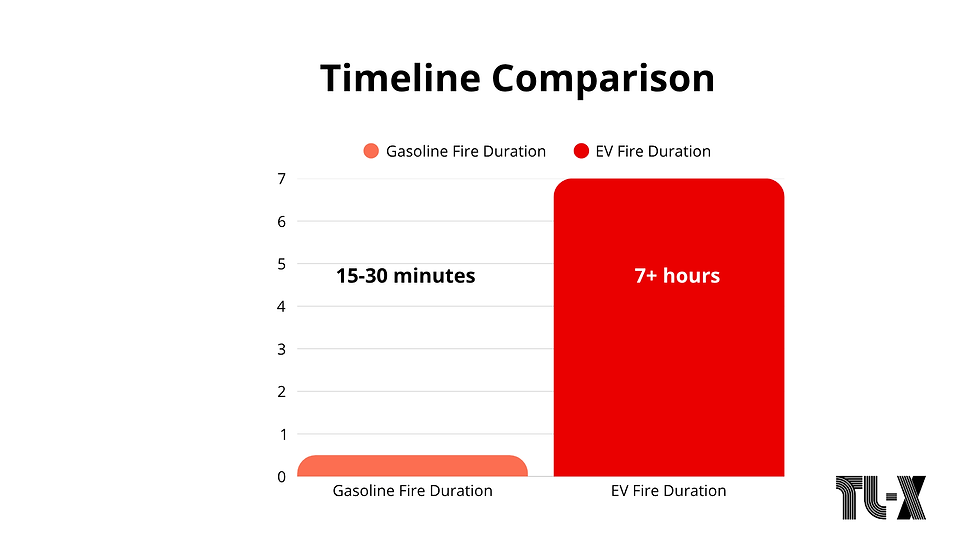
Gasoline fires are typically resolved once the fuel source is removed or isolated.
EV battery fires can burn for hours because:
Thermal runaway may continue inside the pack
Cells may fail sequentially rather than all at once
Residual heat can trigger delayed re-ignition
This prolonged behavior places sustained demands on emergency response and facility safety systems.
Suppression demands: why cooling alone is not enough
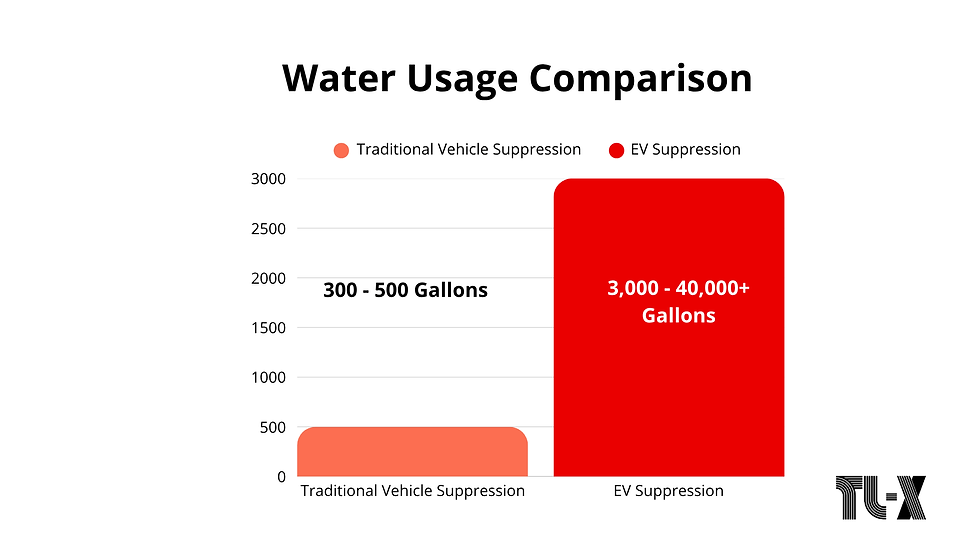
Water plays an important role in cooling battery fires, but the scale is fundamentally different.
EV battery incidents may require:
Extremely large volumes of water
Prolonged application over many hours
Direct access to battery packs, which is often limited
Cooling can reduce temperature, but it does not neutralize OFF-GAS already released, nor does it stop internal chemical reactions if thermal runaway continues.
Toxic emissions: a hidden safety risk
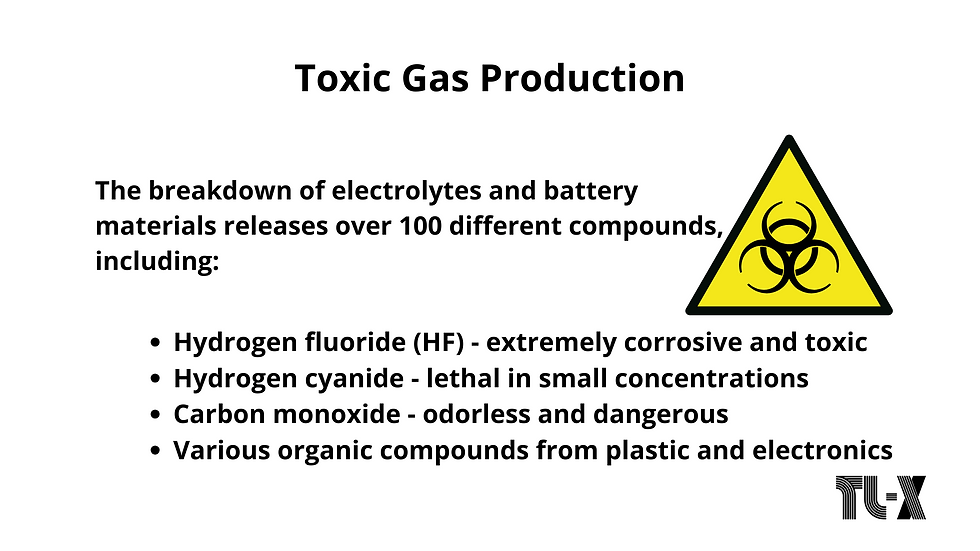
EV battery fires can produce complex mixtures of:
Flammable gases
Toxic byproducts
Irritating and corrosive compounds
These emissions pose additional risks to:
First responders
Facility occupants
Confined or enclosed environments
Not all smoke is equal — and battery fire emissions require different safety considerations.
Propagation: why one cell rarely stays isolated
In gasoline fires, spread depends on external fuel pathways.
In battery systems:
Heat transfers directly between adjacent cells
OFF-GAS ignition accelerates temperature rise
A single cell failure can escalate into full pack involvement
This built-in propagation risk is why battery fire mitigation must focus on early-stage intervention, not just visible flame suppression.
Why EV fires often re-ignite
Re-ignition is uncommon in gasoline fires once fuel is removed.
In EV battery incidents, re-ignition occurs because:
Thermal runaway may not be fully terminated
Residual heat continues internal reactions
OFF-GAS may be released after suppression appears successful
This behavior explains why EV fires can reignite hours — or even days — later.
The critical takeaway
EV battery fires are not fuel-limited fires.They are internally driven chemical failures.
That difference explains why:
Conventional suppression strategies struggle
Cooling alone is often insufficient
Early intervention before OFF-GAS dominates is critical
Understanding this distinction is essential for modern EV and energy storage safety planning.


Comments